

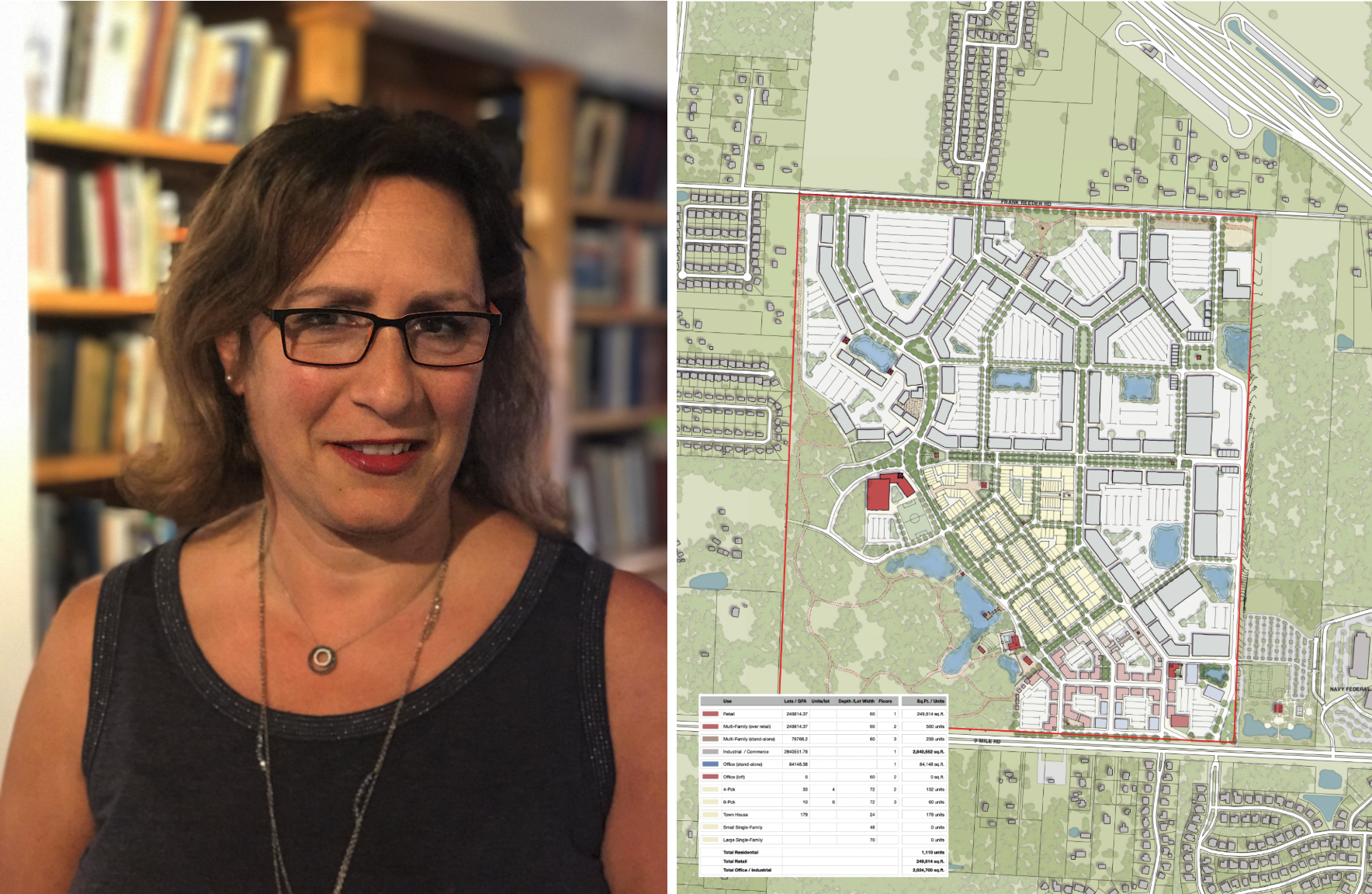
Right: 2021 OLF-8 Hybrid Plan by DPZ
Protect OLF-8’s future from suburban sprawl | Opinion | June 28, 2026
This June, DPZ’s Marina Khoury submitted an opinion piece to the Pensacola News Journal outlining the importance of preserving DPZ’s design code for OLF-8 as it was adopted, with significant public support. This is in the wake of efforts to alter the code for a site north of Pensacola, FL, into a more conventional, suburban sprawl version. Read the full letter below:
A developer is trying to change OLF-8’s legally adopted, walkable design code into a weaker suburban version, and Escambia County must defend the public’s plan. That threat makes it important to remember how we got here.
From 2019 to 2021, the DPZ team developed a master plan and design code for the OLF-8 site through a process that was contentious, but also collaborative and productive. It was a hard compromise, rooted in public trust. We believed that whatever master plan moved forward, the adopted design code would protect OLF-8’s essential promise: good urbanism, walkability, flexibility, and a lasting public realm.
Escambia County and its residents have invested deeply in this process, and we want it to succeed. That is why we were stunned to learn that Tri-W has submitted its own design code that would replace the code they should be required to follow. It is a fundamental departure from the public process that shaped this important site.
To be clear, the adopted code need not be frozen in time. The County’s Land Development Code process exists for a reason: amendments may be appropriate when justified, publicly reviewed, and faithful to the code’s intent. That same discipline worked for Pensacola’s West Main Master Plan, where Mayor D.C. Reeves, the developer, and architects took a proactive approach and welcomed DPZ’s review for plan compliance, yielding a better outcome for residents.
At first glance, the proposed revisions may appear isolated. They are not. Taken together, they shift OLF-8 away from a form-based, walkable, mixed-use framework and toward a conventional suburban model marked by separated uses, wider roads, larger blocks, weaker connectivity, and more automobile dependence.
I have not reviewed every proposed change, but the revisions to streets, blocks, and the public realm alone raise serious concerns. These are not minor adjustments. They change the physical framework that determines whether OLF-8 can become walkable, adaptable, fiscally efficient, and capable of evolving over time.
Why do the proposed changes move toward wider streets, larger blocks, and weaker connectivity? These changes consume more land, require more infrastructure, raise maintenance costs, diminish walkability, reduce frontages, and limit flexibility.
Five proposed changes that would undermine adopted OLF-8 design code
- The Regulating Plan (the master map with streets, blocks, and building types) shifts from form-based to use-based. The DPZ-drafted OLF-8 code focused on the physical form of buildings and public spaces, allowing a healthy mix of uses to evolve within a coherent urban structure. The proposed changes regulate primarily by land use, with residential uses restricted to a more limited area.
Why this matters: Form-based codes help create resilient places that can respond to changing markets and community needs. Locking uses into narrow areas reduces flexibility, limits mixed-use neighborhoods, and increases the likelihood of single-purpose districts that become less vibrant over time.
- Street design standards have been dramatically widened. The proposed code increases travel lanes from about 10 feet to 12 feet and parking lanes from about 7 feet to 10 feet. Pavement widths generally increase from about 36 feet to 44 feet.
Why this matters: Street width strongly influences vehicle speed. Wider lanes encourage faster driving, regardless of the posted speed limit. Twelve-foot lanes belong on highways and transit corridors, not pedestrian-oriented neighborhoods. Wider pavement also increases crossing distances, stormwater runoff, infrastructure costs, and the dominance of cars.
- The street hierarchy has been removed, and parking in front yards is too prominent. The DPZ-drafted code established a hierarchy of streets calibrated to context, function, and surrounding development. The proposed code changes weaken that framework. Based on the master plan, front-yard parking also appears far too prominent, placing cars, driveways and garages at the foreground of neighborhood life.
Why this matters: Without a meaningful hierarchy, street design becomes generic and disconnected from place. When front yards permit parking, parking and service functions move to the front of lots, weakening the street edge and undermining the walkable public realm the original code was intended to protect. - On-street parking has been removed or restricted in many locations. The changes proposed reduce opportunities for on-street parking.
Why this matters: On-street parking is not just a parking supply issue. It is a simple tool for making pedestrians feel safe, especially along residential streets. While cars parked in front yards cross paths with pedestrians in sidewalks, cars parked along the street create a buffer between moving traffic and sidewalks. And they narrow the perceived width of the street, naturally slowing traffic. - Block structure standards have been removed. The proposed code changes eliminate maximum block perimeter requirements and no longer regulate block size or structure.
Why this matters: Block size is a strong predictor of walkability. Smaller blocks provide more route choices, shorten walking distances, distribute traffic more efficiently, and create more development frontages that evolve over time. Large blocks do the opposite. They reduce connectivity, concentrate traffic, lengthen pedestrian trips, and make adaptation more difficult.
OLF-8 is too important to be reshaped through a quiet substitution of standards after years of public work. The adopted code was not perfect, but it carried the hard-earned balance of community compromise. Replacing it now with a more suburban, less connected framework would not be refinement. It would be retreat.
Escambia County should insist that the adopted OLF-8 design code remains the controlling framework. The public process meant something. The code should mean something too.